[Self-Drive] Tokyo & Daikoku Custom Car Driving Tour
![[Self-Drive] Tokyo & Daikoku Custom Car Driving Tour](https://cdn.getyourguide.com/image/99/tour_img/92491a6fe81ec3180e6186a6ea3a55d27a13f0e5c3f3576d040c9b4393d91fda.jpg)
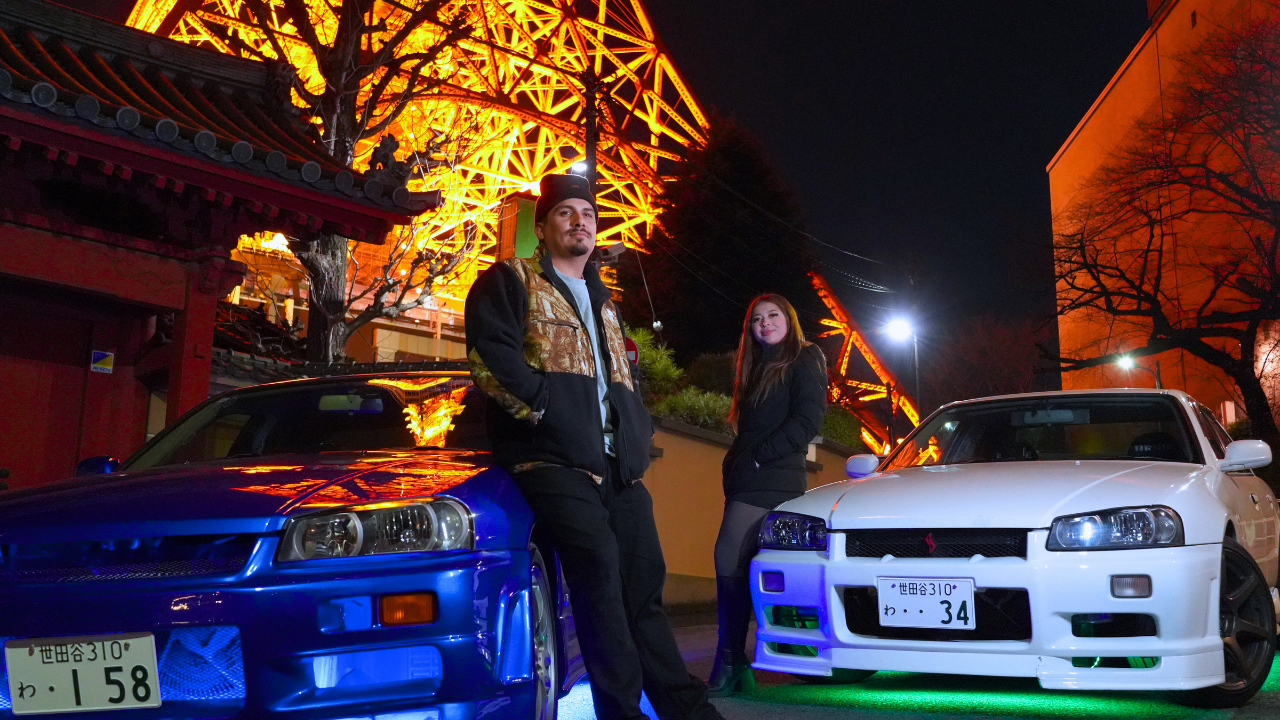
The longest-running self-drive Daikoku product on the platform: ER34 Skyline 5MT or JZA80 Supra 6MT, behind a lead car.
$502per group up to 4
★ 4.927 reviews
What you actually need to sit behind the wheel of an ER34 Skyline or a JZA80 Supra in Tokyo — which International Driving Permit Japan accepts and which it refuses, the six nationalities that need a JAF translation instead, the age and manual-transmission floors, the credit-card excess, and what a Japanese accident report involves. Plus the three bookable self-drive products in our Daikoku set, and an honest account of why a lot of visitors are better off in the passenger seat.
Buying a JDM car is a different subject and this is not the page for it. A large share of searches near "JDM self-drive Tokyo" are actually about importing or purchasing — what cars cost in Japan, where to buy, whether they are cheaper. We do not cover buying, exporting, auction houses or import compliance, and nothing here should be read as guidance on them. This page is about renting one for an evening as a visitor. If you came here to buy, a specialist exporter is the right destination, not a tour site.
This is where self-drive bookings fail. Every operator in this set states, in writing, that a driver who cannot produce the original documents is refused on the day with no refund. The check happens before you see the car.
Japan recognises IDPs issued under the 1949 Geneva Convention on Road Traffic. JAF — the Japan Automobile Federation, the body that issues the translations and the site's own reference authority — states that IDPs issued in accordance with other treaties, including the 1968 Vienna Convention, are not valid in Japan. This catches out drivers from countries that issue Vienna-format permits by default, who arrive holding a document that is perfectly valid at home and worthless at a Tokyo rental counter. Check which convention your issuing body prints on the booklet before you fly.
One caveat you should not ignore — and where other guides get it wrong. JAF's current published list names six countries: Switzerland, Germany, France, Belgium, Monaco and Taiwan. It is consistent across JAF's own English pages and its official translation-service PDFs, including the edition dated April 2026. Slovenia is not on it, and neither is Italy. Slovenia does appear in a great many older write-ups, because it was on the list historically and was removed — which is exactly why the error keeps propagating. One of the self-drive operators in this set still lists seven in its own booking conditions, adding Slovenia; a second lists exactly the six. If you hold a Slovenian, Italian or Estonian licence, do not rely on an old blog post: you will most likely need a Geneva 1949 IDP, and you should confirm directly with JAF and with the operator before you pay.
An IDP or a JAF translation is good for driving in Japan for one year from the date you enter the country. Leave and re-enter, and the year restarts from re-entry. After twelve months of continuous presence a foreign licence stops working regardless of what paperwork accompanies it, and a Japanese conversion is required. For a two-week trip this is academic — but it does mean a permit issued ten months ago is still perfectly usable, which surprises people who assume the issue date governs.
Photocopies, phone photos and PDFs are refused. Bring the physical permit or translation, the physical domestic licence, and your passport — the passport is how the age check is done. US military personnel and dependants have a separate route via a SOFA licence, which two of the three listings in this set spell out explicitly.
Japan's legal minimum driving age is 18. No JDM self-drive operator will rent to an 18-year-old. The gates below are drawn from the three products' own published conditions.
The excess itself is the part travellers underestimate. On ordinary Japanese hire cars the collision waiver typically leaves a modest deductible; on twenty-five-year-old chassis with irreplaceable bodywork, the figures are an order of magnitude higher, and tyres, wheels and undercarriage damage are commonly excluded from cover altogether. That exclusion is not a technicality on a lowered car with a front lip — kerbing it in a car park is a guest-pays repair. Our driver-requirements section on the homepage carries the excess figures published by the specialist rental operators.
Two facts do most of the work here, and neither is intuitive to visitors from countries with an exchange-details-and-move-on culture.
None of this is a reason not to drive. It is a reason to buy the zero-deductible add-on where it is offered, to photograph the car thoroughly before you leave the shop, and to accept that the first twenty minutes of an unfamiliar right-hand-drive manual on the Shuto Expressway at night is not the moment to be filming.
The phrase suggests a rental counter, a key, and an open evening. That is not what any of the three products in this set is. All three are convoy tours: a guide's car leads, you follow, and the route is fixed in advance.
One operator publishes its rules in full, and they are worth reading before you book rather than after:
"You must follow the lead car. You may not travel any route other than the one specified… Revving the engine is prohibited. Heavy use of half clutches is prohibited. Do not run the engine into the red zone."
That is a fair and sensible set of conditions for handing a twenty-five-year-old Skyline to a stranger, and it is also a precise description of the experience: supervised, constrained, and much closer to a guided drive than to a car hire. Guests who understand this rate it highly. Guests who booked expecting to peel off toward Hakone do not.
Watch the wording on non-self-drive listings. One product in our Daikoku set is titled as a private tour in a customised R34 and reads, at a glance, like a drive. Its description states the opposite in plain terms: it is not a rental car service, guests are not permitted to drive for safety and insurance reasons, and the owner drives throughout — though you are welcome to sit in the driver's seat for photos. If driving yourself is the point, read the description rather than the title, on every listing.
Longest review history of the three, and the only one with a fourteen-day cancellation window rather than twenty-four hours — plan accordingly.
The longest-running self-drive Daikoku product on the platform: ER34 Skyline 5MT or JZA80 Supra 6MT, behind a lead car.
These are the products in our 83-tour Daikoku set where the guest drives. All three are priced per group, not per person — which changes the comparison completely if you are two or four people. Combined 44 verified reviews at a weighted average of 4.95, from a small base.
Click a column header to sort. Note the unit column: all three are per-group prices, so divide by your party size before comparing them against the per-person meet tours.
| Tour | From | Unit | Rating | Reviews |
|---|---|---|---|---|
| [Self-Drive] Tokyo & Daikoku Custom Car Driving Tour | $502 | per group up to 4 | ★ 4.9 | 27 |
| 【Self-Drive in Tokyo】R34/35 GT-R JDM TOUR to Daikoku PA | $439 | per group up to 5 | ★ 5 | 10 |
| Tokyo: Self-Drive JDM Car Tour with Daikoku PA Visit | $463 | per group up to 5 | ★ 5 | 7 |
Review counts here are small — 7 to 27 — so treat the ratings as directional rather than settled. Prices are GetYourGuide starting prices in USD at the time of compilation.
Said plainly, because the affiliate incentive points the other way: the self-drive products cost more, and we would rather you booked the right one.
There is also a third answer that the best-reviewed trips tend to use: do both, on different nights. A passenger meet tour for the social and photographic half, a self-drive on a separate evening for the driving half. Trying to make one booking carry both jobs is where the disappointed reviews come from.
Yes, unless you hold a Japanese licence, a US SOFA licence, or a licence from one of six countries that use a translation route instead. Japan recognises only International Driving Permits issued under the 1949 Geneva Convention. JAF states plainly that IDPs issued under other treaties, including the 1968 Vienna Convention, are not valid in Japan. Every self-drive product in this set requires the original physical document — digital copies and photographs are refused at check-in, with no refund.
Per JAF, holders of licences issued in Switzerland, Germany, France, Belgium, Monaco and Taiwan drive in Japan using a certified Japanese translation of their domestic licence rather than an IDP. The translation must be carried together with the original licence and, where the translation notes one, its appendix. JAF's fee for a temporary-driving translation is ¥6,000 tax-exempt, applications are online only, and typical processing is 2–3 business days — though JAF flags that some licences take considerably longer.
One year from the date of entry into Japan, not from the date the permit was issued. If you leave Japan and re-enter, the clock restarts from the re-entry. After a year of continuous presence, a foreign licence stops being valid for driving in Japan regardless of paperwork, and a Japanese licence conversion is required. For a two-week holiday none of this bites, but it does mean an IDP issued eleven months ago is still fine if you have only just arrived.
Higher than the legal driving age. Japan's legal minimum is 18, but the self-drive products in this set set their own floors: two require drivers to be 23 or older, and the third excludes drivers under 21. Premium chassis are commonly gated higher again. Expect the age check to be made against your passport at check-in.
Effectively yes. The cars that make these tours worth booking — ER34 Skyline, JZA80 Supra, R34 GT-R — are manual, right-hand drive, and in several cases more than twenty-five years old. One listing in this set makes the point twice: it excludes "people who can't drive manual transmission" outright, and warns separately that if no manual vehicle is available on the day it will contact you to arrange a substitute. If your manual experience is a driving lesson a decade ago, take the passenger option.
Following someone. All three self-drive products in this set are convoy formats: a guide's lead car sets the route and you follow it. One states its rules bluntly — you must follow the lead car, you may not travel any route other than the one specified, revving the engine is prohibited, heavy use of the half clutch is prohibited, and the engine must not be taken into the red zone. That is the honest shape of the product: a supervised drive on a fixed route in an old, valuable, unfamiliar car.
A credit card in the driver's name — not a debit card. Two of the three listings state this as a hard requirement, one of them specifically for the GT-R. The card is for the damage excess, which on rare chassis can run into seven figures in yen. Tyres, wheels and undercarriage damage are routinely excluded from the collision waiver, which matters on lowered cars.
You must call the police on 110, every time, including for a scratch in a car park. Japanese insurance settlement runs on the police-issued accident certificate; without a police report, cover can be refused outright. Mainstream Japanese rental companies also levy a non-operation charge for the revenue lost while the car is repaired — commonly ¥20,000 if the car is still drivable and ¥50,000 if it is not, though specialist JDM operators set their own and higher figures. Read the specific operator's terms; do not assume the mainstream numbers apply.
Take the passenger option if you cannot produce the original paperwork, are under 23, are not confident in a right-hand-drive manual on unfamiliar expressways at night, want to drink, want to photograph the meet properly, or are travelling with people who would rather be looked after than driven. Self-drive if the road itself is the reason you came, and you accept that it is a supervised convoy rather than a free rental.
Tokyo car meet tours · All 83 Daikoku PA tours · 29 operators compared · Full driver-requirements section · Self-drive vs passenger, in depth · R34 GT-R tours
About this page. The three tours listed are the products in our 83-tour Daikoku PA set in which the guest drives. Their prices, ratings, review counts, cancellation terms, age limits, document requirements and driving rules are taken from that compiled GetYourGuide listing data and from the operators' own published booking conditions — including the quoted convoy rules. Nothing here quotes a price or rating that is not in that dataset.
Sources for the licensing claims. The 1949-Geneva-only rule, the six-country translation list, the ¥6,000 fee, the 2–3 business day processing time and the one-year-from-entry validity are from JAF's own English-language "Driving in Japan" pages. The accident procedure — mandatory 110 call, the police accident certificate as the basis for settlement, and the non-operation charge — reflects the published terms of Japanese rental operators; the ¥20,000 / ¥50,000 figures are mainstream-rental norms, not specialist-JDM figures.
The Slovenia question, resolved. Whether Slovenia (and, in some third-party lists, Italy or Estonia) qualifies for the translation route: it does not. JAF's list is six countries — Switzerland, Germany, France, Belgium, Monaco, Taiwan — stated identically across its English "Driving in Japan" pages, its international-services page and its official translation PDFs, the most recent dated April 2026. Slovenia was on the list in earlier years and has been removed, which is why older guides, forum posts and at least one operator's booking conditions still carry it. We have corrected our own homepage and operators page to match JAF.
What we still could not verify. An authoritative figure for specialist-JDM non-operation charges, so we quote only the mainstream range and label it as such. There is also no published Daikoku closure schedule — the ~19:00 figure is two operators' working assumption, not a posted rule — and no authoritative typical-attendance count, so we print no number.
This page contains affiliate links: when you book through "Check availability", GetYourGuide pays us a commission at no extra cost to you. Selection and ranking are independent.
Last updated: . ← Back to destination guide